SymbioIQ: Designing a Medical-Grade Clinical Intelligence Platform
Clinical AI Product Strategy | UX/UI Design | Workflow Architecture | Regulatory Intelligence
Overview
Clinical trial protocols are some of the most complex documents in healthcare. A single protocol may contain hundreds of pages of operational instructions, eligibility criteria, safety monitoring plans, and regulatory obligations spread across multiple sections and tables.
Despite this complexity, protocol review remains largely manual. Clinical operations, regulatory affairs, medical reviewers, and statisticians often review different portions of the document independently.
As protocols become increasingly complex, critical inconsistencies and operational risks can be discovered too late - during IRB review, site activation, or after the study has already started.
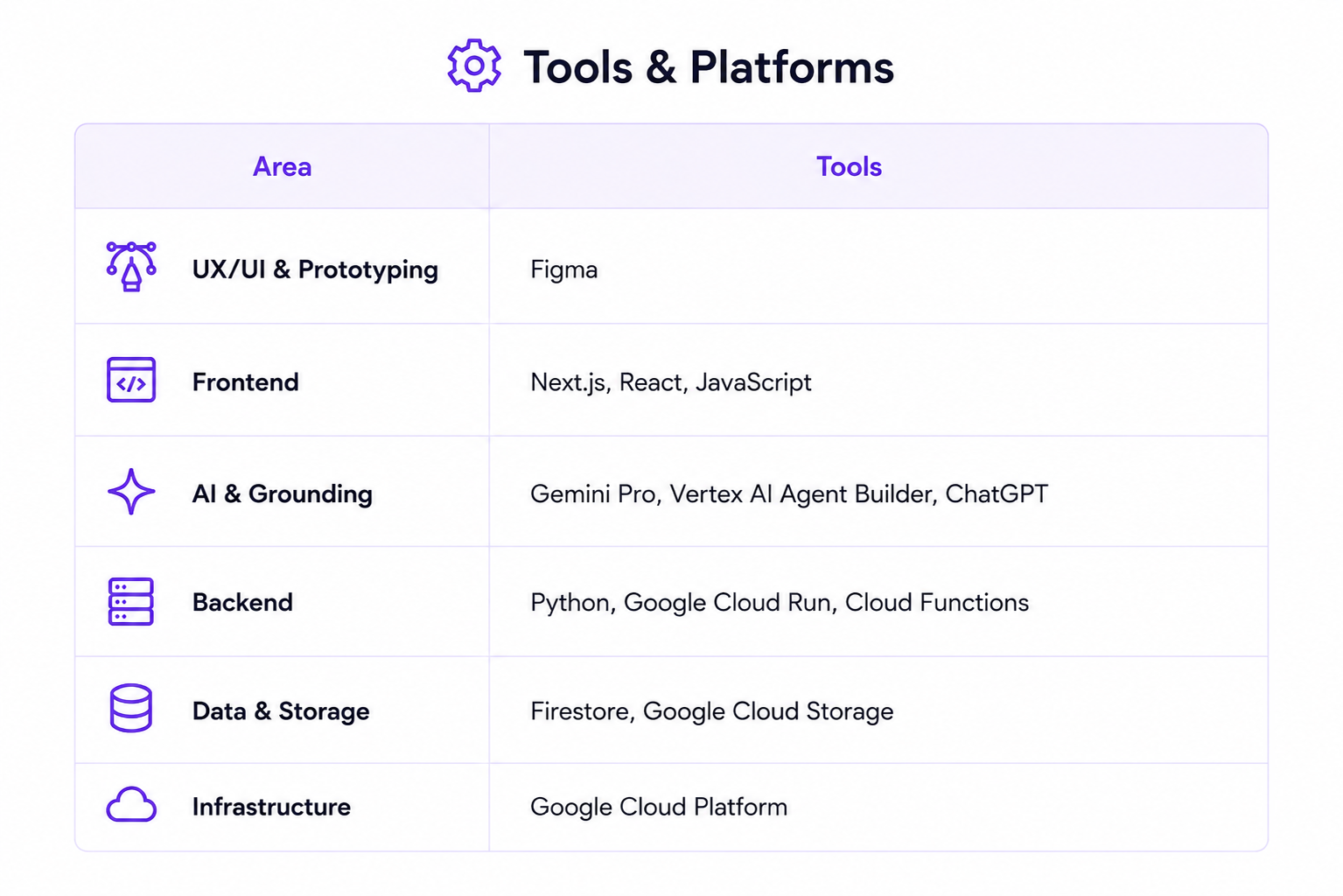
I founded SymbioIQ to close the gap between protocol complexity and the limits of manual review. My focus was to design an AI-supported architecture that can parse complex protocols, surface evidence-linked risks, and allow regulatory experts to focus on high-level strategic validation rather than manual cross-checking.
SymbioIQ was designed as a clinical intelligence platform that transforms dense protocols into structured operational, regulatory, scientific, and safety insights using grounded AI and expert validation.

“Clinical trials don't fail because of missing data. They fail because humans cannot manually process thousands of variables efficiently enough.”
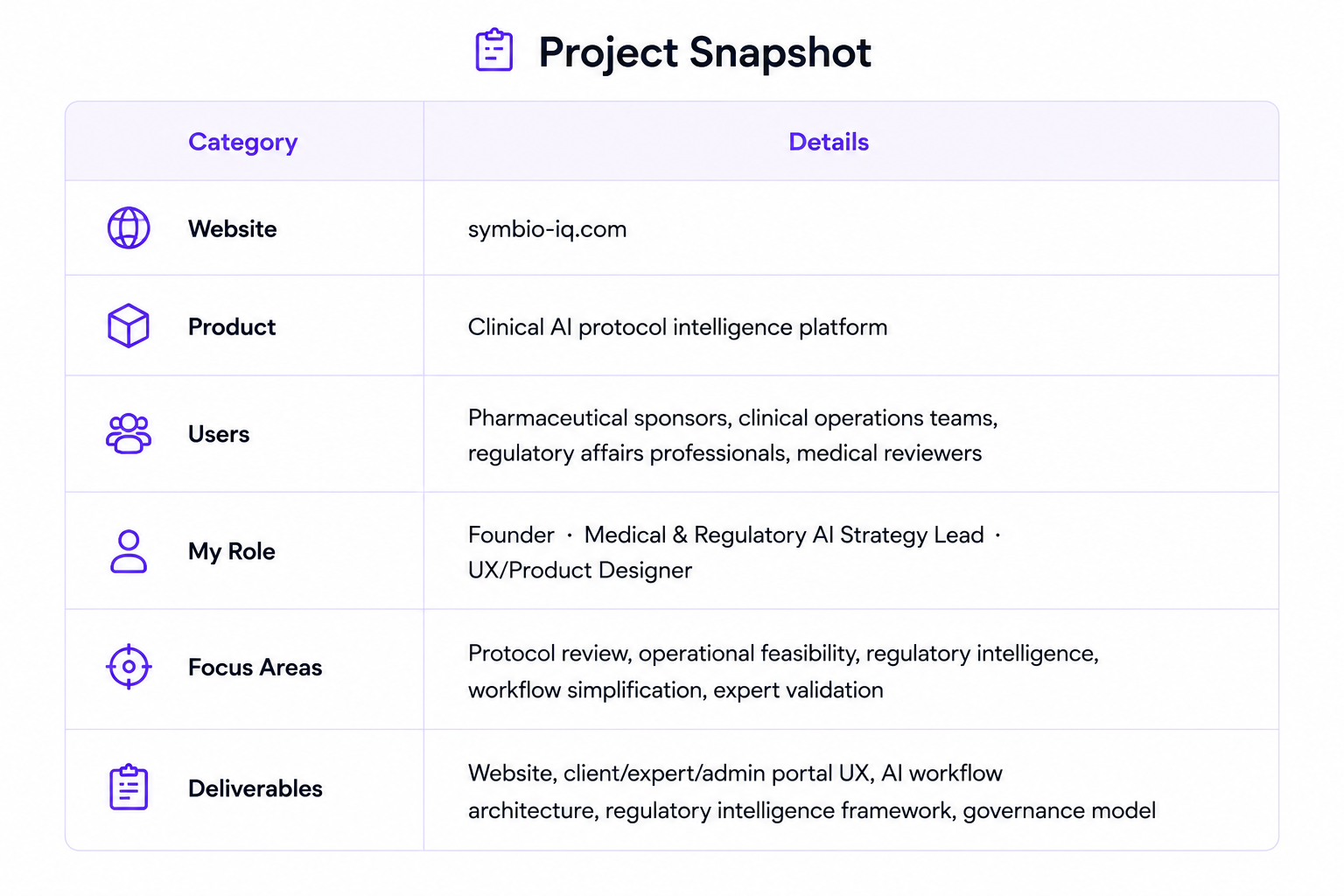
My Role
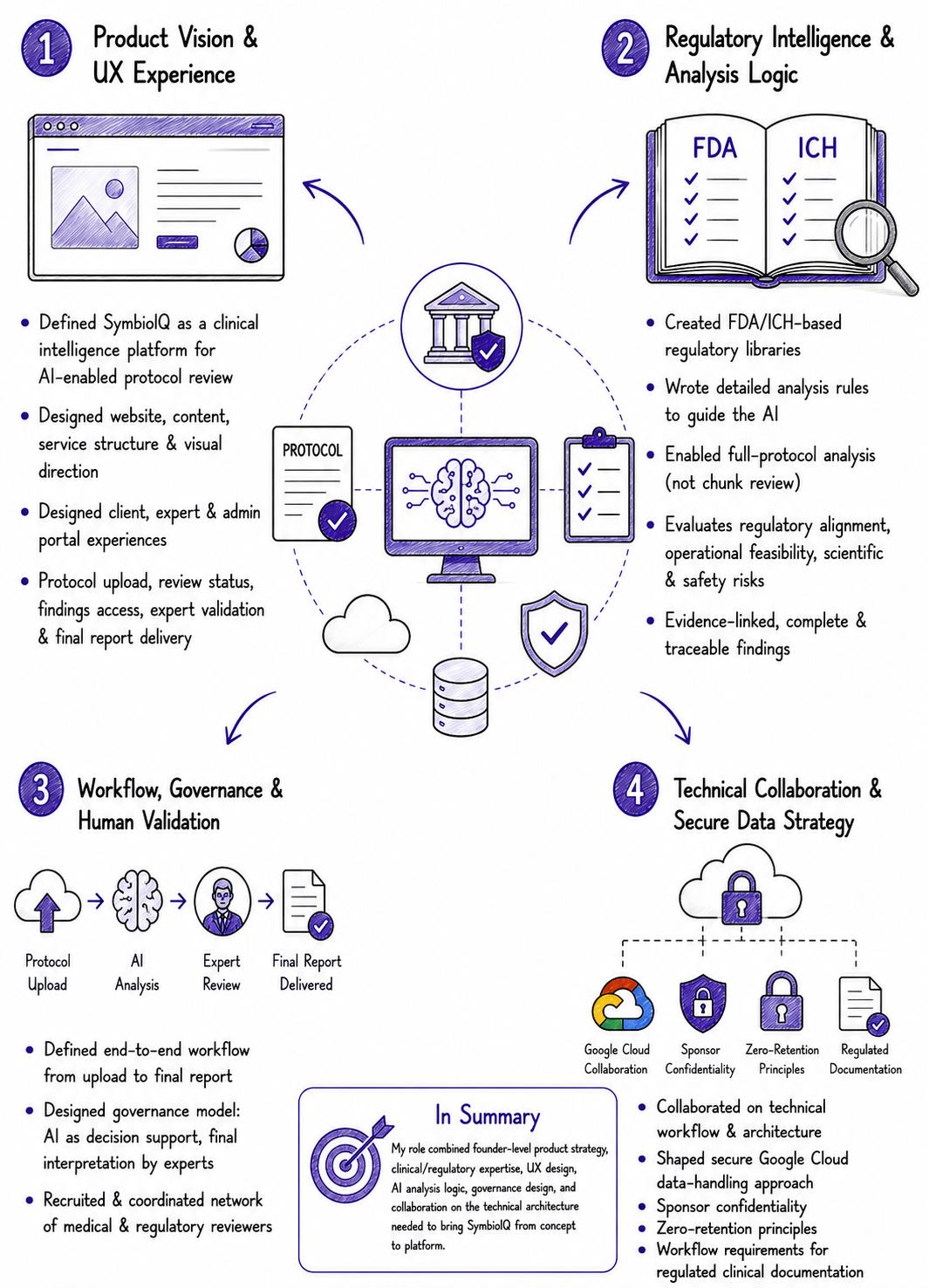
Tools & Platforms
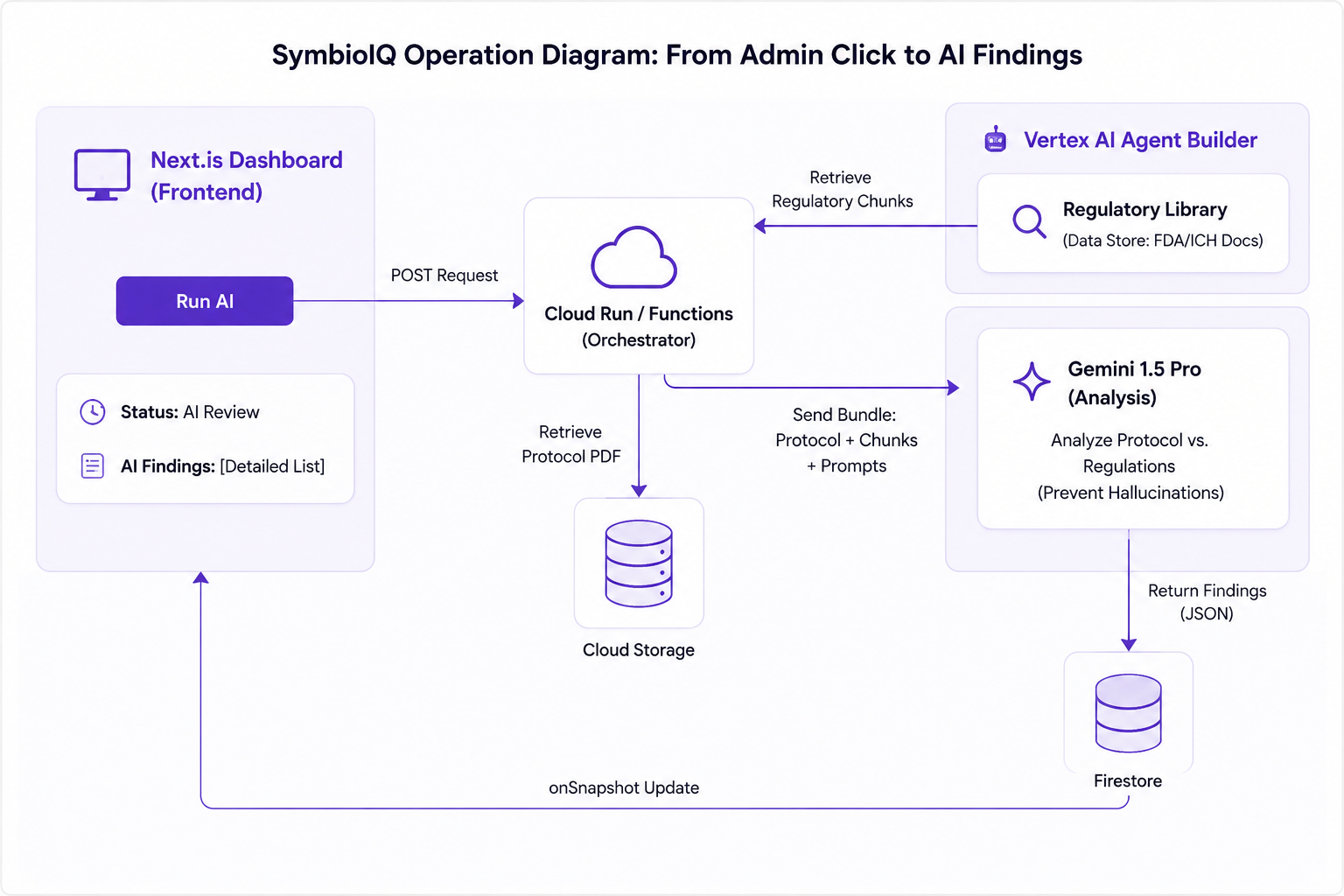
To bring SymbioIQ from concept to working platform, I used a combination of design, AI, cloud, and development tools. While this case study focuses primarily on product thinking and UX strategy, the technical stack demonstrates my ability to translate complex ideas into functional clinical AI workflows.
Clinical Protocol Review Requires More Than AI Summarization
User Problem - Clinical operations, regulatory, and medical review teams often need to evaluate protocols that are hundreds of pages long, with critical information spread across the protocol body, eligibility criteria, safety sections, endpoints, and Schedule of Activities tables.
For these users, the challenge is not simply reading the protocol. The challenge is finding whether the protocol is internally consistent, operationally feasible, aligned with regulatory expectations, and complete enough to move forward with confidence.
Generic AI tools do not fully solve this problem because they often process long documents in isolated chunks. This creates a risk that important details may be missed or disconnected from related information elsewhere in the protocol.
For clinical teams, this creates three major risks:
- • Incomplete protocol analysis
- • Unsupported or hallucinated findings
- • Lack of traceability back to protocol evidence and regulatory source
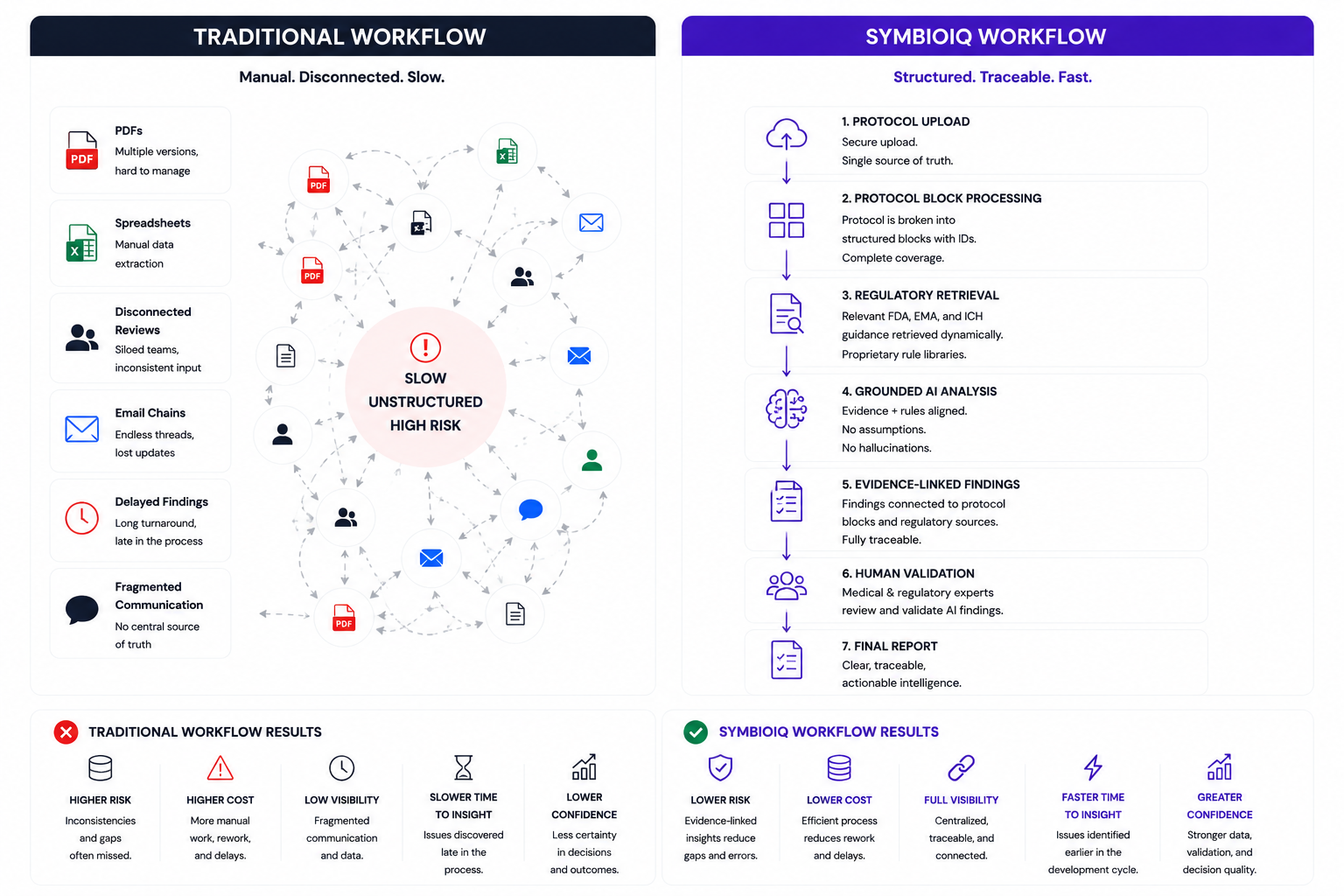
Solution - I designed SymbioIQ around a structured full-protocol analysis model. Instead of treating the protocol as one large document, the system breaks it into smaller, trackable units. Every paragraph and Schedule of Activities row becomes a structured block with its own ID, allowing each finding to be traced back to the exact location in the protocol.
To improve regulatory accuracy, I created proprietary regulatory intelligence libraries based on FDA, EMA, and ICH guidance. These libraries translate complex regulatory guidance into structured rules that the AI can retrieve and apply during protocol review.
Each finding is evidence-linked: the system identifies the exact protocol section or Schedule of Activities row that triggered the finding and connects it to a relevant reference from official FDA, EMA, or ICH guidance.
Before final delivery, human experts validate the outputs to confirm that the findings are accurate, clinically meaningful, and appropriately supported. See the Analyze & Validate Demo below.
Making Clinical AI Usable for Busy Review Teams
User Problem - Clinical operations, regulatory, and medical teams do not need to see how the AI system works behind the scenes. They need a clear, reliable way to submit a protocol, understand its review status, and receive validated findings without managing technical complexity.
Without a clear user experience, the platform could feel confusing or too technical for clinical stakeholders.
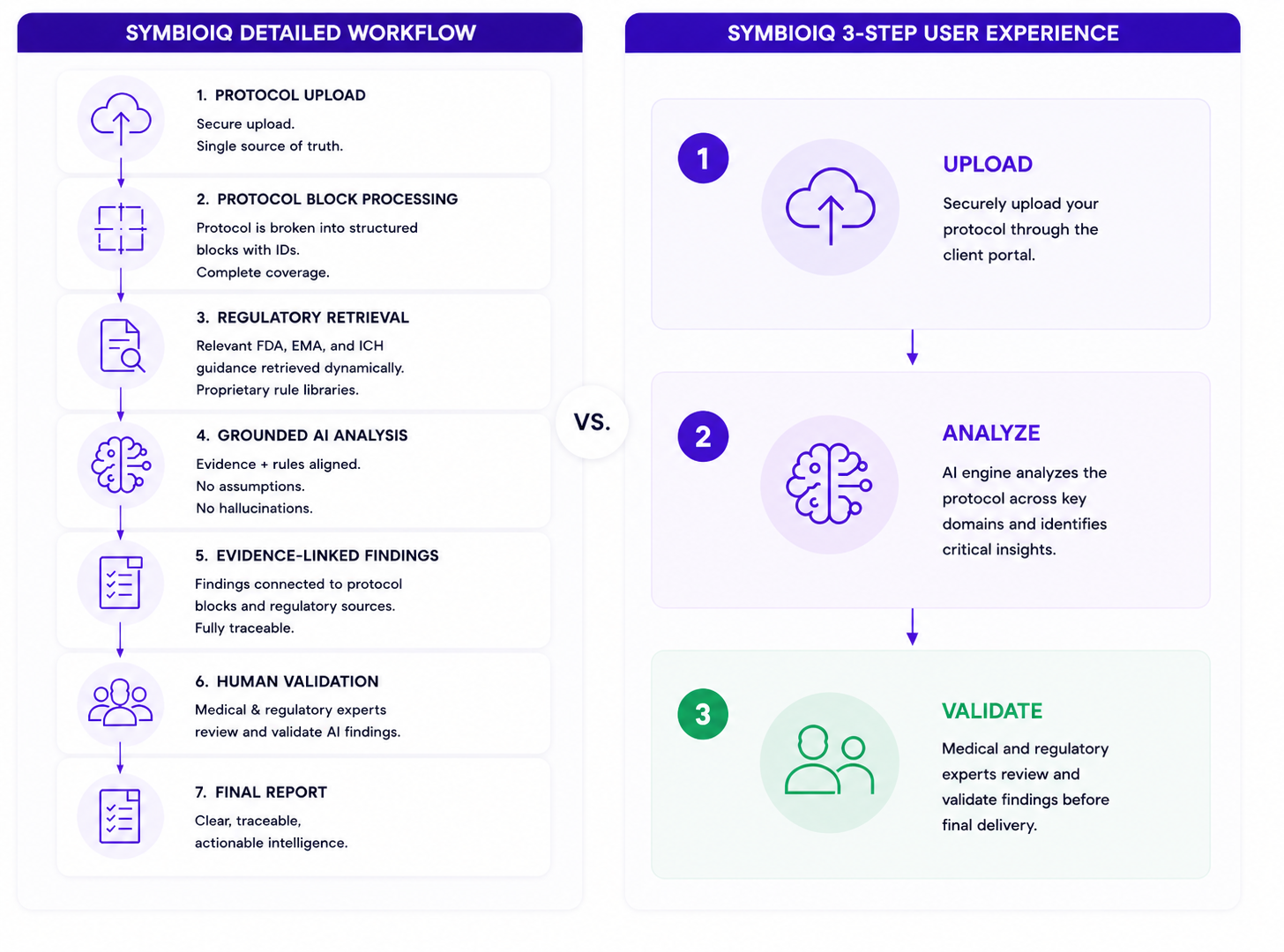
Solution - I simplified the user-facing experience into three clear stages:
- Upload
- Analyze
- Validate
This three-step structure keeps the user experience intuitive while allowing the intelligence layer to remain behind the scenes. Clinical users can focus on decision-making, not on managing the AI workflow.
Product Demo: From Upload to Validated Findings
Upload Protocol Demo
Shows how users submit a protocol through the client portal.
Analyze & Validate Demo
Shows how the platform presents AI findings and how expert validation fits into the workflow.
Identifying Operational Risks Before Trial Execution
User Problem - Clinical operations teams and trial sponsors need protocols that are not only scientifically sound, but also practical for real-world execution at trial sites.
A protocol can look strong from a regulatory or scientific perspective while still creating operational problems for sites. For example, visit schedules may be too dense, procedures may be difficult to coordinate, instructions may be unclear, or the Schedule of Activities may not fully align with the protocol body.
These issues are often discovered too late, after site activation or during study conduct, when they can lead to site confusion, protocol deviations, enrollment challenges, and avoidable amendments.
Solution - I designed SymbioIQ to evaluate operational feasibility as a core part of protocol intelligence, not as an afterthought.
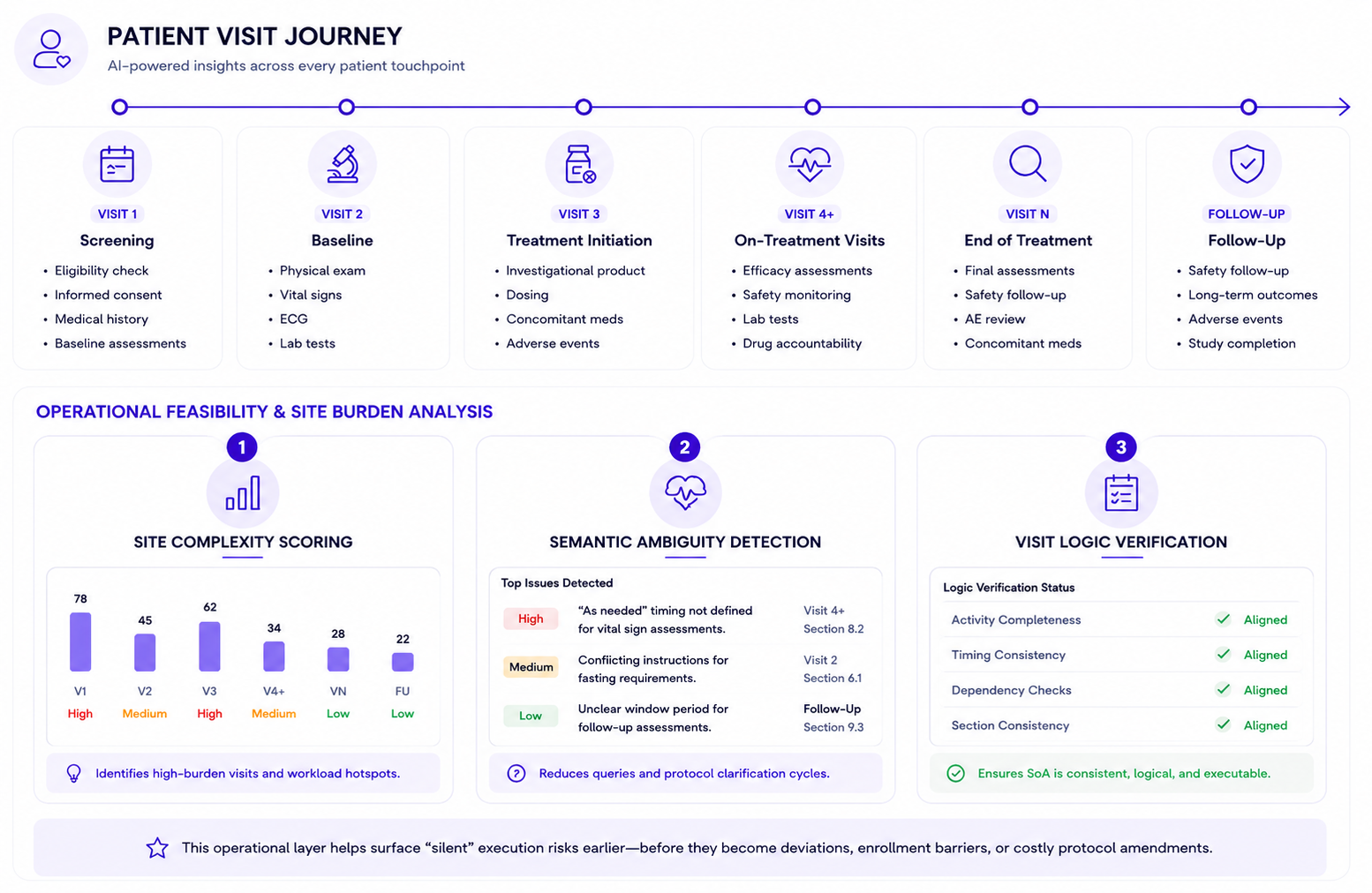
The platform analyzes the Schedule of Activities, visit frequency, procedure complexity, ambiguous instructions, patient burden, and workflow intensity at trial sites.
This became the foundation for Operational Feasibility & Site Burden Analysis, including:
Site Complexity Scoring - quantifies workload per visit to identify operational bottlenecks before site selection.
Semantic Ambiguity Detection - identifies vague or contradictory instructions that may lead to site queries.
Visit Logic Verification - checks whether the Schedule of Activities aligns with the protocol body.
This operational layer helps surface "silent" execution risks earlier, before they become deviations, enrollment barriers, or costly protocol amendments.
Designing Trust for Regulated Healthcare
User Problem -
Clinical teams and pharmaceutical sponsors cannot use AI outputs as a black box. They need confidence that the platform is secure, traceable, expert-led, and appropriate for sensitive clinical documentation.
For these users, trust is created not only through a polished interface, but through clear evidence, controlled access, review transparency, and human oversight.
Solution - I designed SymbioIQ around two layers of trust: visual trust and workflow trust.
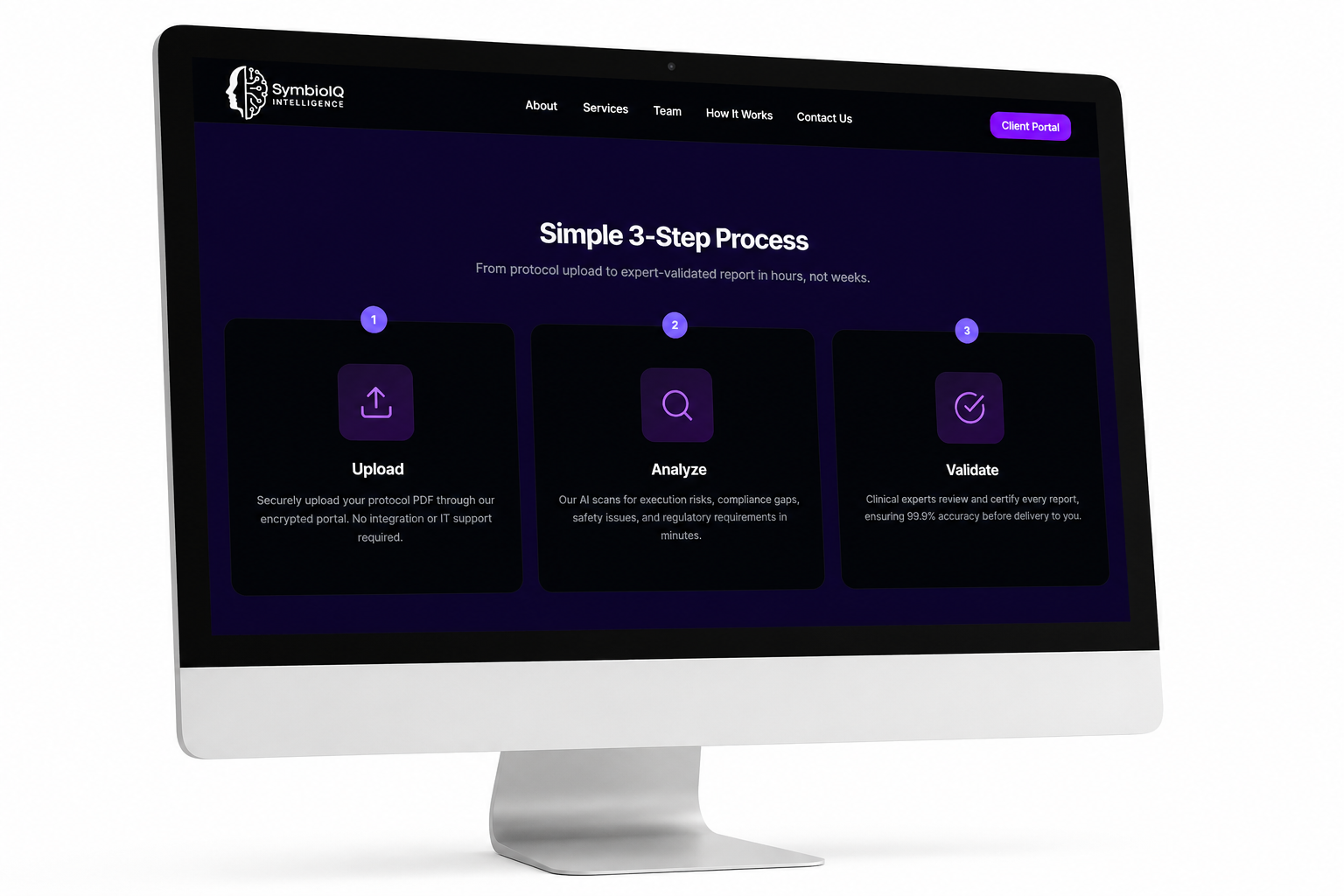
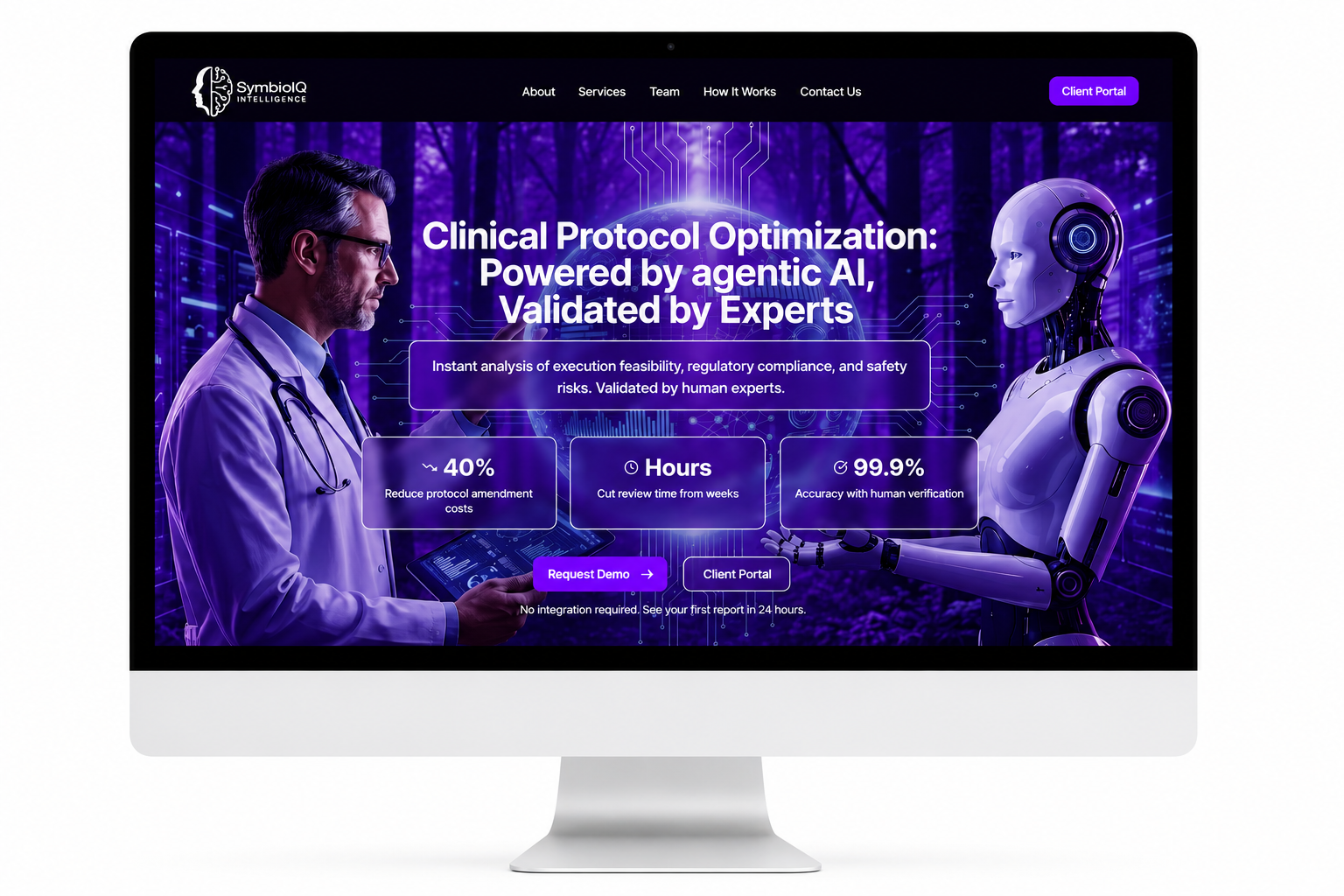
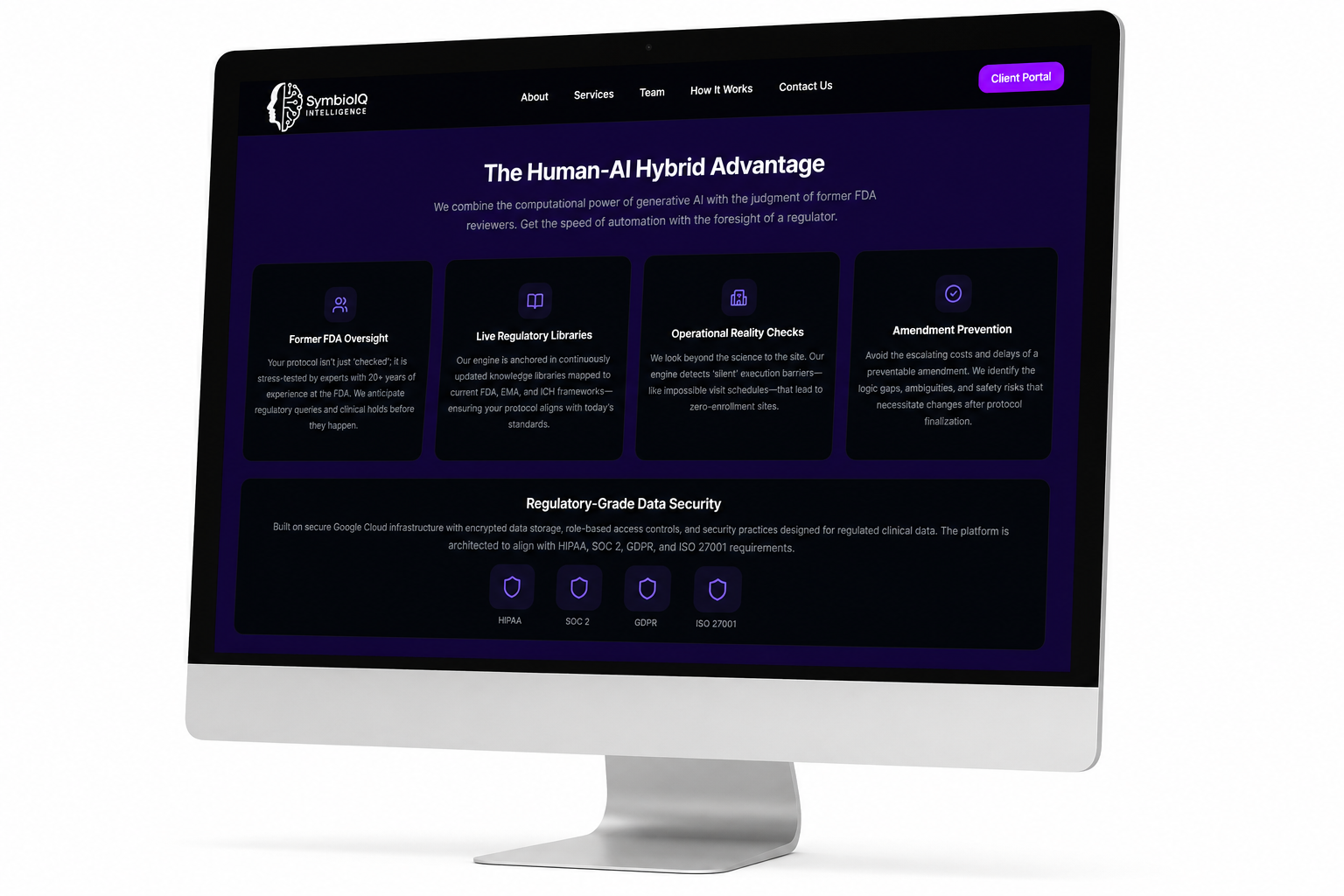
The visual system uses a premium medical-intelligence aesthetic with dark backgrounds, deep purple gradients, high-contrast typography, glassmorphism-style cards, AI network visuals, and structured content blocks. This design direction was intended to communicate medical-grade intelligence, security, enterprise readiness, and regulatory seriousness.
From a workflow perspective, trust was supported through encrypted data handling, role-based access for client, expert, and admin users, audit trails, structured review steps, and human-in-the-loop governance.
AI outputs were intentionally positioned as decision support, not final medical or regulatory interpretation. Final review remains with qualified medical and regulatory experts, helping the platform feel both technologically advanced and clinically responsible.
Website Design System Showcase
Reflection
SymbioIQ reinforced something I have always believed: in healthcare, trust is part of the user experience.
Designing clinical AI products is not only about creating polished interfaces. It is about helping users navigate complexity with confidence, understand where findings come from, and preserve expert judgment in high-stakes environments.
This project allowed me to combine medicine, regulatory science, AI strategy, workflow architecture, and UX design into one product experience built for real-world clinical decision-making.